

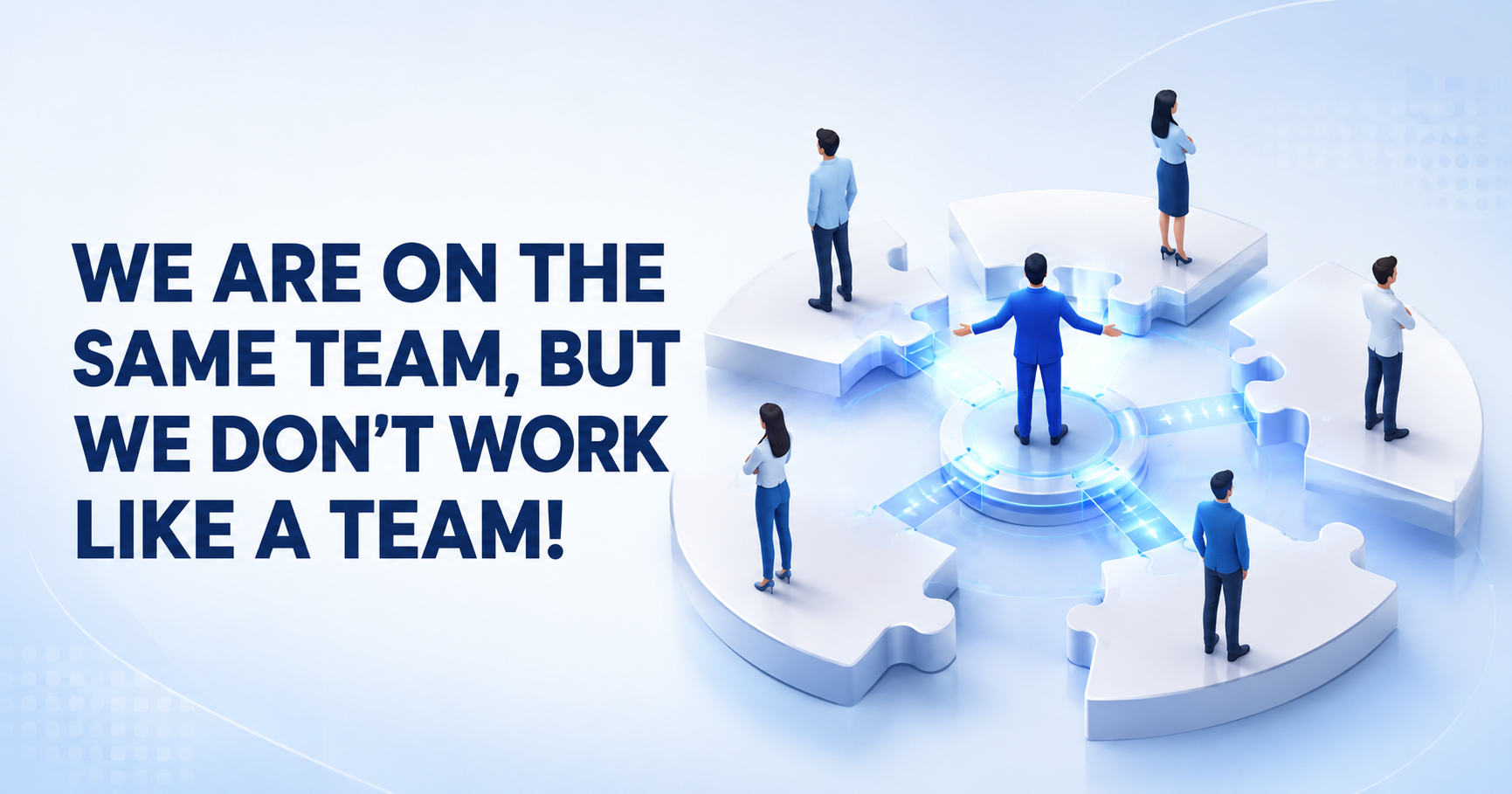
This is probably one of the most common pitfalls facing many project teams.
Everybody knows how important teamwork is. But as the project progresses, problems and complaints arise, and teammates start pointing fingers at each other.
When that happens, the project manager takes the most heat, especially when something does go wrong.
Because the PM is responsible for keeping project execution running smoothly and for its outcomes.
When anything bad happens, the PM is often the first person to be held responsible.
Or, in plain English, the PM is the one to blame!
I’ve seen this kind of situation happen many times across different types of projects and at several companies over the past 20 years.
I’ve found two common reasons why this happens so easily, and they are closely related.
The first is that the project team focuses too much on dividing up work and responsibilities rather than cooperating.
And if the project manager also becomes one of those people who keeps arguing about R&R, roles and responsibilities, rather than clarifying problems and removing obstacles, you can imagine how chaotic the project team can become!
A PM is not just someone who leads and controls schedules, tasks, and deliverables.
A PM is also the glue and facilitator who can resolve disagreements and help the team move forward smoothly.
Avoid The RACI Trap
A widely used tool for defining a project team’s responsibilities is the RACI matrix.
RACI stands for Responsible, Accountable, Consulted, and Informed.
A RACI matrix defines:
- Who is responsible for completing each task or delivering each result.
- Who is accountable for approving or signing off on the result.
- Which subject-matter experts should be consulted.
- Who should be kept informed about the project’s status.
The RACI matrix is a useful tool for mapping stakeholder roles and responsibilities for project tasks.
But this tool can’t tell us how people in those roles should cooperate once their responsibilities are assigned.
Therefore, it is the PM who helps ensure that team members can work seamlessly while fulfilling their assigned duties.
“Isn’t it everyone’s obligation to work together? That’s a basic part of the job, isn’t it?”
Well, yes, in theory.
But in reality, people often need someone to lead them and keep everything aligned.
Like a flock of birds flying across a strait in a V-formation, a project team needs coordination and direction. The PM helps provide that leadership. Without it, the entire formation can fall apart.
However, many project teams and PMs overlook this and assume that as long as everyone follows the RACI matrix and completes their assigned tasks, everything should go well on its own.
That’s exactly how teams fall into the RACI trap!
The problem is not the RACI matrix itself. It is how people use it.
Defining roles and responsibilities is the foundation for how a team works together.
The key is turning those defined responsibilities into effective cooperation.
Foster Teamwork with Rationality and Facts
With that said, how can project managers facilitate cross-functional cooperation?
People tend to say no to tasks they believe don’t fall within their responsibilities.
Two weeks ago, I encountered exactly this kind of situation.
We are currently working on an AI application that generates charts based on user prompts.
I participated in the project as the Project Director, responsible for overseeing the project overall and helping the PM coordinate cross-functional issues.
After the first round of system integration testing, the PM and I found the system wasn't stable enough.
Sometimes the model generated a beautiful chart with the correct figures. At other times, it produced crazy stuff.
We met with the AI and web development teams to discuss how to resolve the problem.
During the meeting, the AI team blamed the web development team for providing a problematic database schema, while the web team argued that the AI team needed to tune its model more effectively.
The only thing both teams agreed on was, “That’s not our problem!”
“Well, just tell me who the hell is responsible for this. It’s my head on the chopping block now!” the project manager yelled.
Of course, this outburst didn’t resolve the issue. Therefore, I stepped in.
I asked the AI team, “What do you need to make the model’s responses more reliable?”
“A database schema with much better descriptions for the data fields,” the AI team answered.
“Could you provide a few examples?” I asked.
Then I turned to the web team and asked, “Do these examples make sense to you? If so, how much time do you need to refine all the field descriptions?”
After a few rounds of back-and-forth questions and answers, both teams and the PM stopped blaming each other and started a deeper discussion about how to solve the issue with very limited time and resources.
People have emotions, and they don’t like having their shortcomings pointed out.
Therefore, they may try to get the monkey off their own backs and place it on someone else’s.
But people are more willing to listen when the discussion is based on facts.
As long as we put the facts on the table and discuss them rationally, we can foster better teamwork.
Deal with Emotions through Humor
But we have to admit that people have emotions.
Some people hide their emotions to remain professional, while others use them as a weapon against people or situations they don’t like.
In short, it can be difficult for people not to become emotional when things go wrong.
We PMs are often the ones expected to deal with those emotions.
I think one of the best ways to defuse an awkward or even confrontational situation is through humor.
I know that’s hard.
I don’t have an especially strong sense of humor myself.
But thankfully, AI can now assist us with that.
Two years ago, one of the PMs on my team became involved in an escalating email confrontation with a procurement manager.
The more emails they exchanged, the more emotional the conversation became.
At that point, replying while feeling angry or defensive could easily have made the situation worse.
Instead of replying immediately, the PM did something interesting.
She removed all sensitive information before sharing the necessary background and context with ChatGPT. She then asked:
“Can you help me analyze the tone of the procurement manager’s message and draft a polite response with a touch of humor, while still maintaining my position?”
ChatGPT helped her separate the facts from the emotional language and suggested a response that acknowledged the procurement manager’s concerns without accepting inappropriate blame.
More importantly, the suggested response kept her position clear while using a light touch of humor to lower the emotional temperature of the conversation.
She reviewed and revised the response before sending it.
And that email brought the email fight to an end!
In many situations, a rational appeal may not be the best way to defuse intense emotions.
Responding with humor can sometimes make it easier for the other person to save face and return to a more rational state of mind.
If a PM can develop this kind of interpersonal communication skill, it becomes much easier to foster a collaborative team culture built on mutual understanding and acceptance.
Enjoy Being A Leader
A project team is not just a group of people assigned to a project.
It is a group of people who work seamlessly together to achieve a shared project goal.
But every team needs someone who can resolve conflicts, lead constructive discussions, and facilitate teamwork.
And that work belongs to the team lead, the project manager.
This does not mean that the PM should carry everyone’s responsibility or become the person to blame whenever something goes wrong.
It means that the PM must create the conditions in which people can clarify problems, resolve disagreements, and act as one team.
That is how a collection of people assigned to the same project becomes a real project team.
And you, as the project manager, are the key to making that happen.