
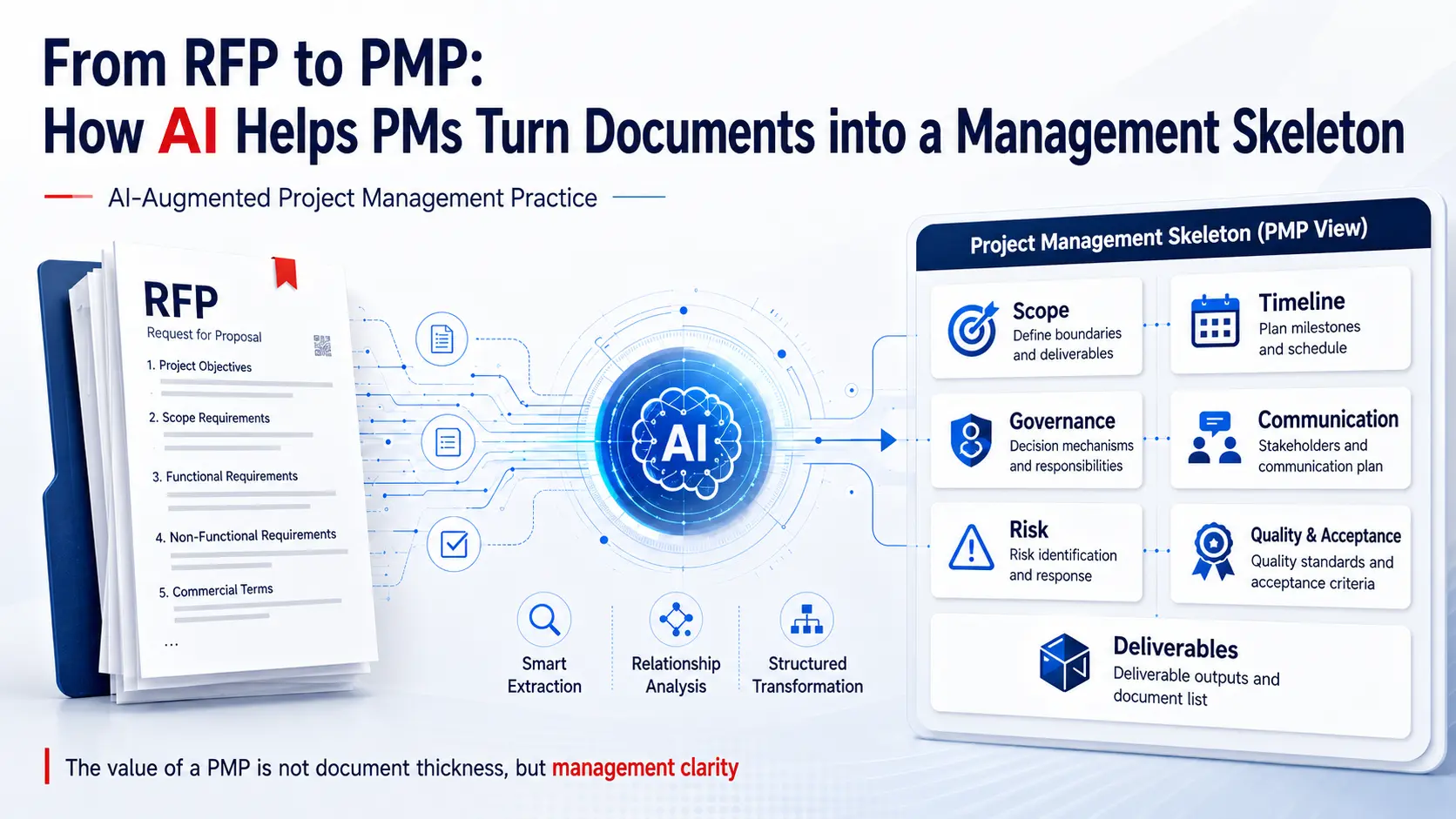
The Value of a PMP Is Not Document Thickness, but Management Clarity
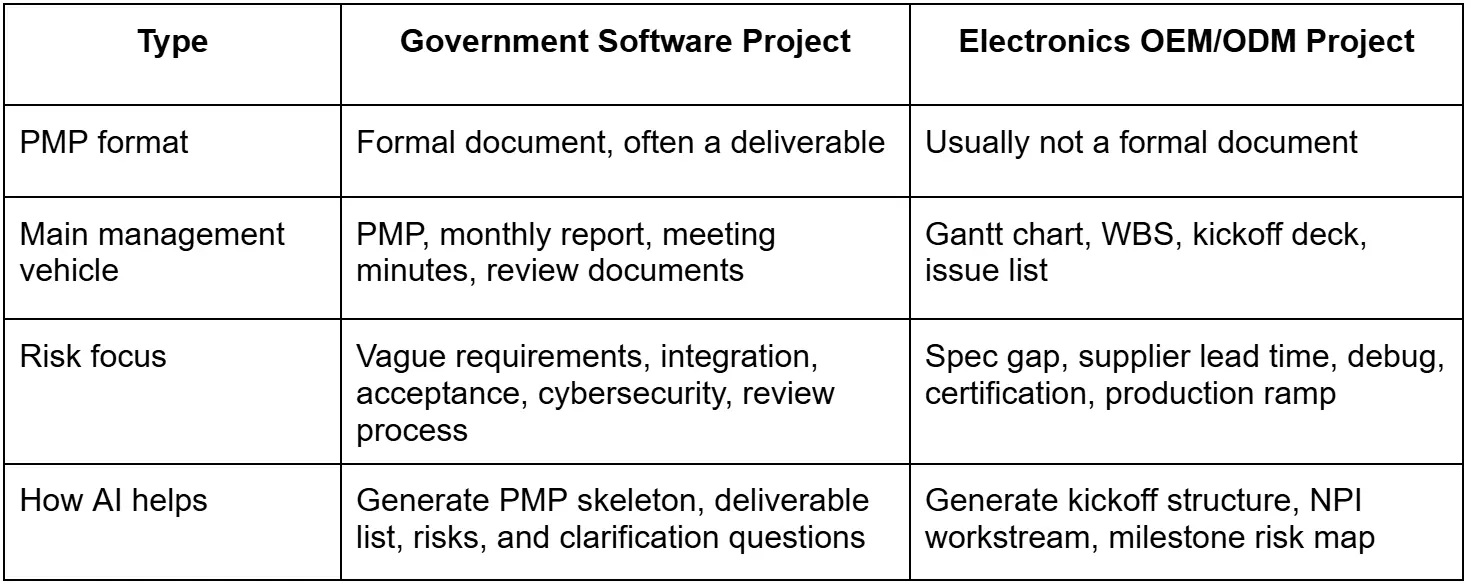
Although the project types differ, the management problems are similar.
Therefore, the point is not to list a standard PMP template.
The point is to think from the perspective of real project management and ask:
What structures can AI help us extract from the RFP to make the project manageable, trackable, and communicable?
1. Scope Skeleton
Scope defines the execution boundary of a project.
AI can help PMs extract the functional scope, modules or subsystems, deliverables, and document, training, and maintenance requirements, as well as work items that may not be explicitly stated but still need to be confirmed.
But the PM still needs to judge:
Do these items really belong to the project scope?
Which items are only reasonable assumptions made by AI?
Which items must be clarified with the customer before kickoff?
The scope skeleton is not yet the formal WBS. It is a way for PMs to first understand the major blocks of work included in the project.
2. Timeline Skeleton
After the scope is clarified, PMs can ask AI to identify the contract start date, milestones, review checkpoints, document submission deadlines, testing and acceptance deadlines, maintenance period, training schedule, and possible dependencies from the RFP.
But the point here is not to ask AI to directly create the schedule.
AI may not know whether internal resources are sufficient, how long the supplier lead time will be, how fast the customer can review and respond, when the test environment will be ready, or whether the data integration team will cooperate.
So what AI can do is help organize the schedule skeleton and remind PMs not to miss schedule-related signals in the RFP.
The baseline schedule still needs to be judged by the PM based on the real situation.
3. Governance Skeleton
The governance skeleton defines how the project will be managed.
AI can help PMs extract from the RFP information related to project organization, roles and responsibilities, meeting mechanisms, progress reporting, issue tracking, change review, escalation paths, and customer review or approval points.
In government projects, some RFPs clearly require weekly meetings, monthly reports, working meetings, and review meetings. Sometimes these are even part of the acceptance criteria.
But some RFPs only say:
“The vendor shall cooperate with the agency in project management and progress reporting.”
This may seem vague, but it means the PM must clarify the governance model further.
For example:
Should there be weekly meetings?
What should be included in the monthly report?
Who can approve requirement changes?
How long can an issue remain unresolved before escalation?
Who makes the final decision on acceptance disputes?
The value of AI is to turn vague requirements into concrete governance questions, so the PM can confirm them with the customer and the team before kickoff.
4. Communication Skeleton
A large part of a PM’s work is communication.
In this area, AI can help PMs organize stakeholders, teams that require regular updates, issues that require formal records, documents that require review, information that requires version control, and communication items that must be documented.
But a communication plan is not just a list of meetings.
It defines how information flows.
The PM still needs to dynamically adjust the stakeholder list and communication approach during the project, based on the actual situation, to prevent misunderstanding or information gaps from slowing the project down.
5. Risk Skeleton
AI can help PMs identify early risk signals in an RFP.
These may include incomplete requirements, multi-system integration, unclear data sources, vague acceptance criteria, an overly compressed schedule, missing customer review time, third-party API dependency, insufficient cybersecurity requirements, or underestimated documentation workload.
But what AI identifies is only risk signals, not final risk conclusions.
The PM must judge:
Which risks are only theoretically possible?
Which risks are likely to become real problems under this customer, this team, and this timeline?
This is one of the biggest differences between AI-Augmented PM and AI-generated documents.
AI highlights the signals.
The PM judges the priority and impact.
6. Quality and Acceptance Skeleton
Many RFP acceptance criteria look complete at first glance, but they often contain ambiguity.
For example:
How do we verify that “the user interface is friendly”?
What exactly does “good performance” mean?
Does “training completed” mean the training session was delivered, or that participants passed a test?
For data migration, should correctness be verified by sampling or full comparison?
Quality and acceptance criteria are important not only for the vendor but also for the customer.
I once learned this lesson the hard way.
In a face recognition PoC project, I served as the customer-side PM responsible for drafting the RFP.
I wrote:
“The camera must recognize a face within 3 seconds.”
My expectation was that once a user stood in front of the camera, the whole process — capturing the image, uploading it to the cloud, running recognition, and returning the result — should take no more than 3 seconds.
But in the actual test, the user waited almost 7 seconds before seeing the result.
The vendor argued that the RFP did not clearly define the starting point. They believed the 3-second timer started only after the camera captured the image and sent it to the server. From that perspective, they did meet the requirement.
But in reality, the user still waited 7 seconds.
If AI had been available back then to review this kind of ambiguous condition, it might have reminded me to define the starting and ending points, as well as the user-perceived response time, more clearly.
So, in the quality-and-acceptance skeleton, AI’s most valuable role is not to polish the wording.
It is to find ambiguous statements and turn them into clarification questions.
7. Deliverable Skeleton
Many RFPs list required deliverables.
But what PMs really need is a deliverable management structure.
AI can help PMs organize what needs to be delivered at each stage, which documents require review, which deliverables are tied to payment milestones or acceptance, which items are system outcomes, which are management documents, and which are training or maintenance documents.
Because PMs do not only need to know the list of deliverables.
They also need to know each deliverable’s review responsibility, due date, acceptance criteria, and potential risks.
I suggest asking AI to first organize deliverables into a management table:

The most easily overlooked item is often the “pass criteria.”
The 3-second versus 7-second example above is not only a technical issue. It directly affects acceptance.
By using AI to build this kind of management table, PMs can gradually turn delivery requirements into conditions that are trackable, verifiable, and acceptable.
RFP to PMP Skeleton Prompt Framework
Here is a practical prompt framework.
The goal is not to generate the final PMP in one step.
The goal is to first produce a management skeleton that the PM can review, challenge, and refine.
This framework includes four steps:
- Identify: Ask the AI to identify the scope, deliverables, milestones, project constraints, and stakeholders in the RFP.
- Structure: Ask AI to organize the extracted information into a management skeleton rather than directly writing the full PMP.
- Challenge: Ask AI to identify ambiguities, gaps, contradictions, risks, and items requiring clarification.
- Adapt: Ask AI to convert the skeleton into a suitable management format for the project type, such as a government project PMP, an OEM kickoff deck, or an internal project charter.
You can use the following prompt as a starting point:
Please review the attached RFP content, but do not write the full Project Management Plan yet.
First, extract a Project Management Plan skeleton with the following sections:
1. Scope and major workstreams
2. Key deliverables
3. Milestones and schedule drivers
4. Stakeholders and governance structure
5. Communication and reporting needs
6. Quality and acceptance requirements
7. Risk areas and assumptions
8. Open questions that must be clarified before kickoff
For each item, explain:
- Which part of the RFP it is based on
- Why it matters for project management
- What the PM should verify before turning it into the actual plan
When using this prompt, keep two things in mind.
First, before uploading an RFP or any attachment to AI, remove sensitive information such as company names, customer names, pricing, personal data, and system architecture details.
Second, if the document is large, do not upload everything and ask AI to process it all at once. You can first ask AI to process only scope and deliverables, then move on to schedule, governance, risk, and acceptance. This helps prevent the response from becoming too long or losing focus.
Conclusion
AI can help PMs generate a PMP, but they should not aim only for a document that looks complete.
What matters more is whether AI can help us extract the scope, deliverables, schedule, governance, communication, risks, and acceptance conditions from the RFP and turn them into a management skeleton.
The value of a PMP is not document thickness.
Its value is whether it helps the project move forward, stay trackable, remain communicable, and expose problems before they become serious.
In government projects, this skeleton may be formalized as a PMP.
OEM/ODM projects may include a WBS, a Gantt chart, a kickoff deck, and an issue list.
The format may be different, but the management problems are similar.
AI can help PMs build the skeleton, but it cannot make the judgment for them.
That is what I believe matters most in AI-Augmented Project Management:
Not letting AI replace PMs in writing documents, but helping PMs understand how the project should be managed, and turning a document into a project that can truly move forward.