

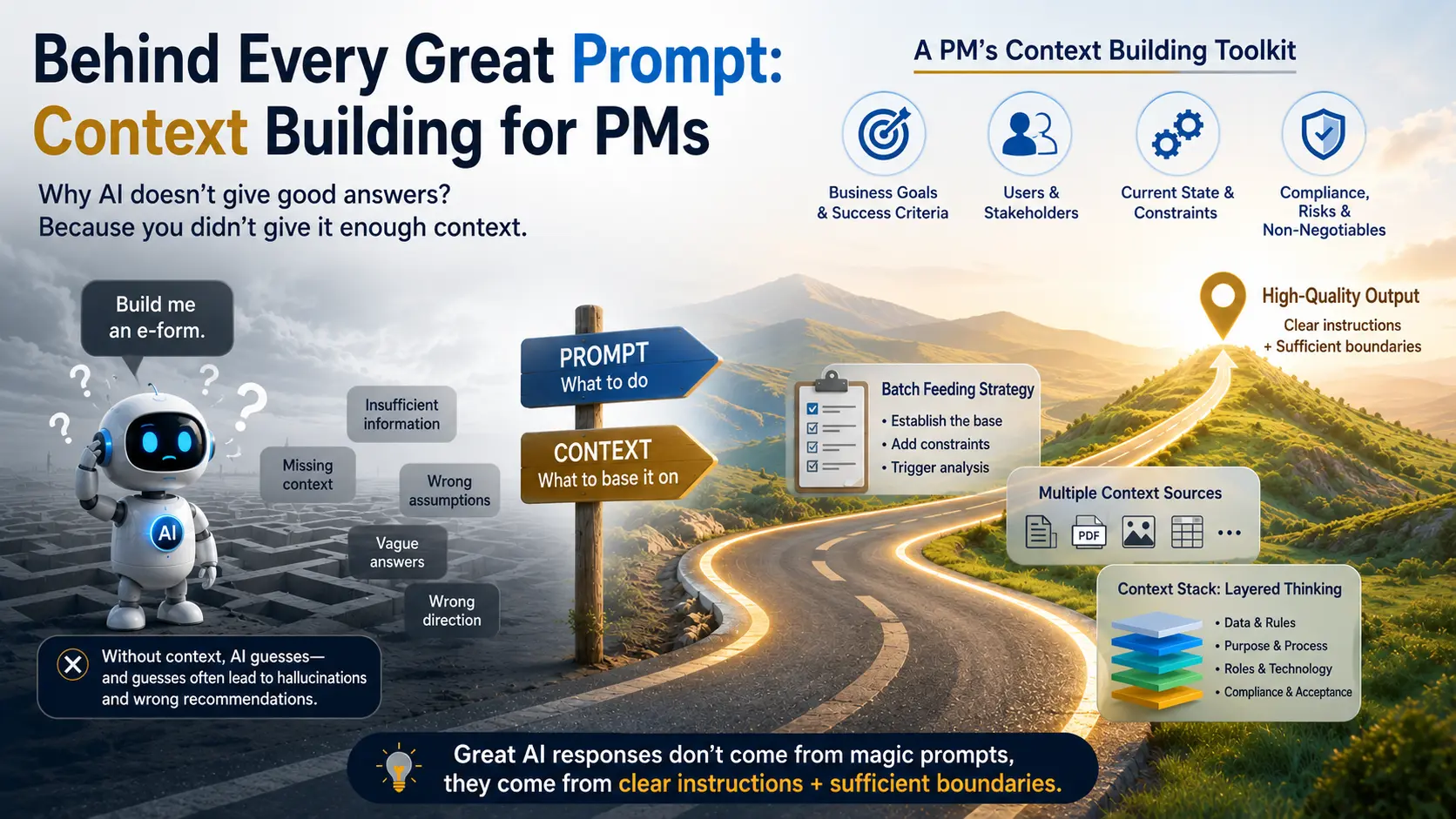
Why doesn’t AI give good answers? Because you didn’t give it enough context.
In my previous article, I shared how PMs can use prompts to help AI reveal hidden assumptions behind requirements. I also provided three prompt templates in RTF format.
At that time, the focus was on “how to ask” and “how to guide AI to think beyond the surface-level request.”
But in practice, the effectiveness of a prompt does not depend only on the question itself. It also depends heavily on the context we provide.
If a prompt tells AI, “What should you do?”
Then context tells AI, “What situation should you base your judgment on?”
Many times, AI fails to give a good answer not because the prompt is not fancy enough, but because it lacks enough context, constraints, and decision boundaries.
In other words, good AI responses usually do not come from one magical prompt. They come from clear instructions plus sufficient boundaries.
What Is Context?
Context is often translated as background, context, or situation.
But if we only think of context as the surrounding text before and after a sentence, we may miss the bigger picture. When communicating with AI, context has a much broader meaning.
Here is a simple example.
If I ask you, “What time is it now?”
You answer, “9:30.”
Assume we are in the same office environment during the daytime. You usually do not need to say “9:30 in the morning.” I would naturally understand that you mean morning.
The omitted part, “in the morning,” provides context.
When humans communicate, we do not rely only on words. We also receive signals from the environment, timing, tone of voice, role relationships, company rules, past experience, and shared background knowledge.
The same question, “What time is it now?” may simply be a request for the current time.
But it may also be a reminder that someone should not still be eating breakfast at their desk.
Or, right before a meeting, it may imply that everyone should start heading to the meeting room.
In the human world, even a simple sentence often carries many unspoken signals.
One of AI’s biggest challenges is that it does not always have access to those unspoken signals.
Context Is Not Just Background. It Is the Boundary for Thinking.
Many people think that providing context simply means adding a few background sentences before the prompt.
But for AI, context is not just background information. It is the boundary for judgment.
It affects how AI understands the problem, prioritizes information, avoids incorrect assumptions, and produces answers that fit the real situation.
In a typical requirements analysis scenario for PMs or BAs, context may include several types of information.
First, business goals and success criteria. What problem is this requirement trying to solve? What outcome would actually create value?
Second, users and role relationships. Who will use it? Who will make the decision? Who will be affected? Do different roles care about the same things?
Third, current state and existing constraints. What are the current processes, systems, data conditions, manpower, timeline, budget, or operational limitations?
Fourth, risks, compliance, and non-negotiables. Does the requirement involve personal data, cybersecurity, regulations, internal policies, or known risks?
These pieces of information may look like supporting details, but they actually draw the boundaries of AI’s thinking.
With boundaries in place, AI has a better chance of producing answers that fit reality.
Without boundaries, AI can easily generate a response that looks reasonable but does not actually match your project context.
The Cost of Missing Context: AI Is Not Reading Your Mind. It Is Guessing.
We often say that AI may hallucinate. But in many cases, hallucinations do not happen out of nowhere.
It often comes from insufficient information.
When information is missing, AI tends to complete the answer based on common patterns, general experience, or what sounds reasonable in language.
At that moment, it is not truly understanding your project. It is guessing your project.
Take the simple question, “What time is it now?” as an example.
If AI does not know your time zone, location, and current time, it may give an incorrect or outdated answer.
If AI does not know you are in an office and someone is eating at their desk, it cannot understand that the question may actually be a reminder to follow company rules.
If AI does not know that a meeting is about to start, or what the role, relationship, and current situation are, it cannot understand that the question may actually be prompting people to get ready for the meeting.
This is the cost of missing context.
AI does not automatically know your location, internal company rules, project history, stakeholder concerns, or the real meaning behind a sentence in a specific situation.
If we do not provide enough context, AI can only answer in general terms.
That is why the same prompt may sometimes produce a highly relevant answer, but at other times return only generic suggestions.
A PM’s Context Building Toolkit
For PMs, BAs, and consultants, instead of chasing a universal prompt, it is better to first learn how to build context.
I suggest thinking from the following perspectives.
1. Task Objective
What do you want AI to help with this time?
Is it requirement clarification, risk identification, feature breakdown, specification writing, meeting note summarization, or solution comparison?
Different objectives require different contexts.
What do you want AI to help with this time?
Is it requirement clarification, risk identification, feature breakdown, specification writing, meeting note summarization, or solution comparison?
Different objectives require different contexts.
2. Business Purpose
What problem is this requirement really trying to solve?
For example, developing an overdue payment reminder email is not just about “sending one more email.”
The real goal may be to reduce overdue payments, reduce manual follow-up effort, or improve the effectiveness of customer reminders.
If AI does not understand the business purpose, it may only offer suggestions based on surface-level functionality.
3. Users and Constraints
Who will use this feature? Who will be affected?
What are the limitations around timeline, budget, manpower, technology, operations, customer service workload, or data quality?
Constraints do not limit AI’s usefulness. They make AI’s suggestions more realistic.
4. Compliance, Risks, and Success Criteria
If the requirement involves personal data, cybersecurity, notification consent, audit trails, or internal policies, these must be clearly stated.
At the same time, AI also needs to know what success looks like.
Is the goal to reduce customer service calls? Reduce overdue payment rates? Improve notification delivery rates? Shorten operation time? Or make it easier for users to complete the task?
Without success criteria, AI cannot judge which suggestions matter more.
Context Does Not Only Live in the Chat Box: Multiple Context Sources Matter
Many people provide context by writing background information directly into the prompt.
That is useful, but it is not the only way.
Many AI tools can now process different types of data. This means context does not have to exist only inside the chat box.
It can also come from meeting notes, Office documents, PDFs, system screenshots, process diagrams, scanned forms, user feedback, system specifications, user manuals, policy documents, existing requirement documents, or project risk logs.
These are all multiple sources of context.
For example, in the “assumption mapping” template from my previous article, if the overdue payment reminder email had already been discussed in a meeting, we do not necessarily need to manually summarize everything.
We can provide the meeting notes to AI and ask it to first identify known requirements, decisions already made, open questions, potential assumptions, possible risks, and stakeholders who may need further clarification.
The benefit is not just typing less. AI may receive richer context than what we can quickly summarize on the spot.
However, there is one important reminder.
If you are using a cloud-based AI tool, always pay attention to token usage, company confidential information, customer data, personal data, and information security.
The more complete the context, the better the chance AI has to reason closer to the real situation.
But the more sensitive the context, the more important data governance and security controls become.
Complex Tasks Need a Context Stack
The more complex the task, the more detailed the context needs to be.
For example, suppose you want to turn a paper-based form into an electronic form that users can fill out on a web page.
This may be a scenario that PMs, BAs, consultants, or development teams encounter when adopting AI-assisted development or even vibe coding.
If you simply tell AI:
“Please help me build an electronic form.”
You will usually get a generic template that is difficult to implement.
Because that sentence gives AI only the task, not the context.
A better approach is to build a Context Stack for AI. In other words, provide layered information that helps AI judge and break down the task.
These context layers can roughly be grouped into four categories.
First, source materials and field rules. This includes blank forms, completed samples, field definitions, required and optional fields, date formats, and field dependencies.
Second, business purpose and workflow. This includes why the form needs to be digitized, what problem it should improve, who handles the submission, and whether approval or notification is required.
Third, user roles and technical environment. This includes who fills it out, who reviews it, who searches it, and what devices, browsers, languages, or system architecture it needs to support.
Fourth, security, compliance, and acceptance criteria. This includes data protection, access control, audit trails, and the definition of completion.
The point is not how many layers we list.
The point is to help AI see the full task context, not just a single instruction.
The more complex the task, the less we should expect AI to read our minds.
The more useful context we provide, the better the chance AI has to break down the task correctly.
Don’t Data Dump. Feed Context in Batches.
Providing context does not mean dumping everything into AI at once.
That approach is like a data dump. It may look complete, but it comes with several risks.
AI may take longer to process the information and consume more tokens.
More importantly, key information may be buried inside too much material, causing AI to focus on the wrong things.
If the material contains confidential or personal data, the security risk increases as well.
A better approach is to feed context in batches.
Start by establishing the base, then gradually add constraints, and only then ask AI to perform the full analysis.
For example:
Step 1: Establish the base
“I will first provide the project background. Please summarize the key points, known facts, and possible assumptions. Do not propose solutions yet.”
Step 2: Add constraints
“Next, I will provide meeting notes, constraints, and known issues. Please update the previous summary and identify which questions still need clarification.”
Step 3: Trigger analysis
“All context has been provided. Now, based on the context above, please help me analyze the hidden assumptions behind the requirement, the major risks, and the next questions we should ask.”
The purpose is to let AI digest the context first, instead of jumping into solutions too early.
For PMs, this is especially important.
Often, what we really need is not an immediate answer from AI.
What we need is for AI to help us first clarify requirements, constraints, assumptions, and risks.
Good AI Collaboration Is Not Magic. It Is Context Building.
The same prompt, without context, often leads to generic suggestions.
But when we provide enough background, constraints, role perspectives, known risks, and business goals, AI has a better chance of helping us identify the real problems, the unspoken assumptions, and the business intent behind the requirement.
For PMs, this does not mean we must immediately jump into complex technical implementation.
But we should at least understand this:
High-quality output = clear instructions + sufficient boundaries.
The key to AI collaboration is not inventing magical wording.
It is building a complete project context.
When you learn to provide context, you truly begin to collaborate with AI.