


Recently, OpenAI released its latest image-generation model, gpt-image-2, which demonstrated a noticeable improvement in image quality compared to previous models. The release quickly became a popular topic among users. Earlier this month, on May 12, 2026, OpenAI also officially deprecated the entire DALL-E API series, including its third-generation models, and recommended that developers migrate to gpt-image-2, gpt-image-1-mini, or gpt-image-1 instead.
Unlike the DALL-E series, the gpt-image family is not simply an image-generation model. It is part of a broader multimodal language model architecture. In other words, these models can not only generate images, but also answer questions, create tables, place text directly inside images, and perform many other multimodal tasks.
Naturally, the image quality is significantly better than that of previous DALL-E models. As a result, many people believe that the future belongs to multimodal AI models. However, the significance of this transition goes far beyond better image quality, stronger model capabilities, or the rise of multimodal AI.
Its deeper meaning lies in this:
- Building a verifiable chain of content trust.
Image Provenance and Content Authenticity
Today, it is already clear that AI can generate in seconds what once required human hours, days, or even weeks to create. More importantly, AI can now produce highly realistic images and videos that are often difficult to distinguish from reality.
This also means that phrases such as “seeing is believing” or “photos don’t lie” no longer necessarily hold. What we see may simply be AI-generated content.
As a result, concepts such as image provenance and content authenticity are becoming increasingly important. Even if content is AI-generated, we should at least be able to understand how it was created.
Image provenance refers to the ability to trace information from metadata or invisible watermarks embedded inside digital content, including:
- Who created the content
- Which tools were used
- When it was generated
- Whether AI was involved
- Whether the content was later modified by AI
This forms the foundation of a verifiable chain of content trust.
In reality, OpenAI is only one of many companies currently moving in this direction.
C2PA and SynthID
For example, the female robot image shown below can be verified through the Coalition for Content Provenance and Authenticity (C2PA) verification site. The verification results reveal that Google Media Processing Services generated the image on February 2, 2026, and later modified it.
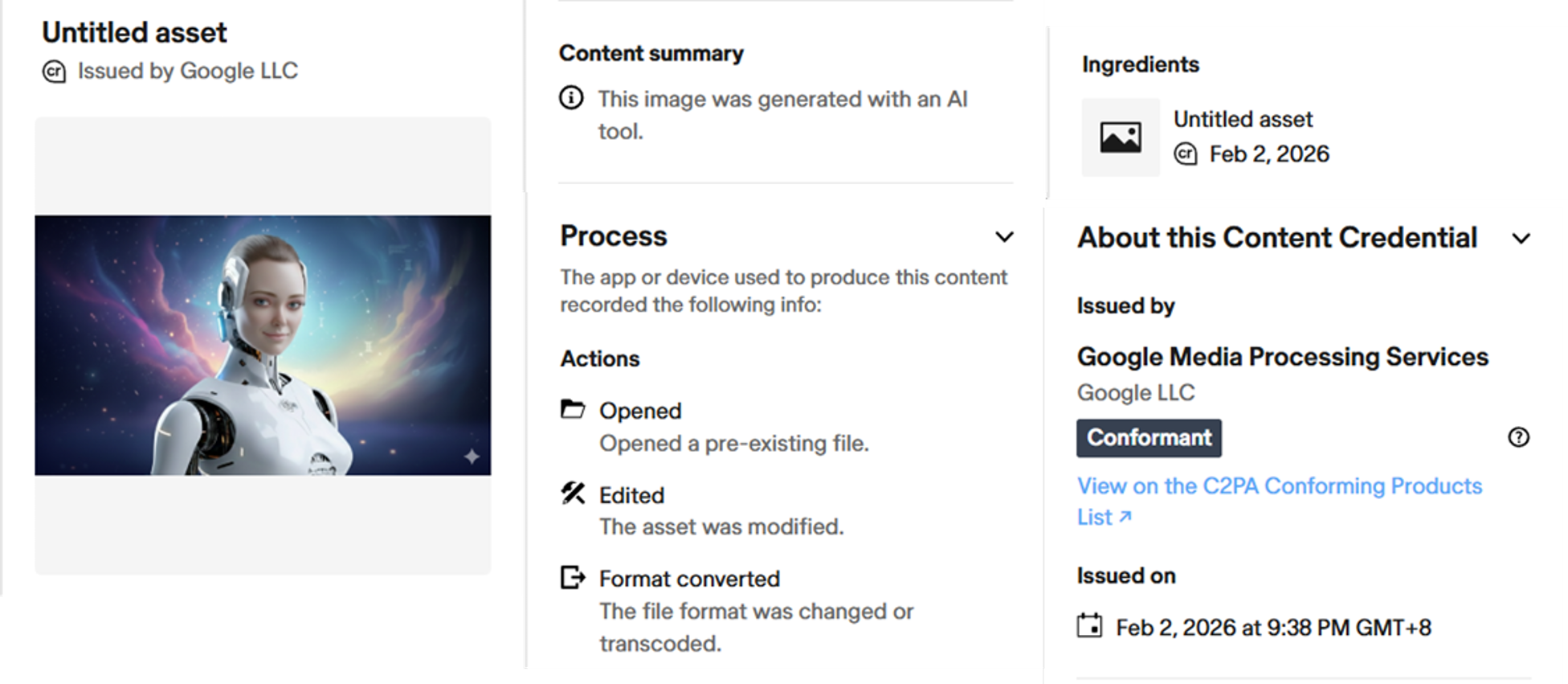
This is indeed accurate.
I generated the female robot and background separately at different times and later combined them using Gemini on February 2, 2026.
Although the current verification information still cannot fully trace the entire creation history of the source images, it can already confirm that the final image was AI-generated and derived from pre-existing assets.
The verification record explicitly states:
- Opened a pre-existing file
- Asset was modified
C2PA is an industry-wide Content Provenance Standard
jointly promoted by organizations such as Adobe, Microsoft, OpenAI, Google, BBC, Intel, ARM, and Truepic.
Its goals include:
- Recording content provenance
- Verifying whether content has been modified
- Labeling AI-generated or AI-edited content
- Building verifiable chains of trust
Users can generate traceable media simply by using platforms, tools, cameras, or devices that support the C2PA standard.
In fact, users can even add C2PA information to their own images using open-source tools such as c2patool. However, C2PA also has limitations.
Because metadata can be modified or removed, many social platforms automatically strip metadata from uploaded images. Once an image is edited again, the original metadata may also change or disappear.
This is where another technology, SynthID, becomes important.
SynthID is an invisible watermarking technology developed by Google DeepMind.
It is currently embedded into Google’s own generative AI products and model outputs, including images, audio, text, and video.
The name SynthID comes from:
- Synthetic
- Identity
Unlike C2PA, which primarily focuses on metadata and content provenance records, SynthID embeds watermark signals directly into the image itself.
As a result, even if an image is cropped, compressed, or modified, parts of the SynthID signal may remain detectable. This helps address one of the major limitations of metadata-based provenance systems.
Currently, however, SynthID adoption remains limited, as only Google and a small number of selected media partners can embed SynthID in media assets.
That said, the technology was only introduced a little over two years ago, and its broader adoption remains highly promising.
Conclusion: From Content Generation to Content Trust
The next generation of AI systems will no longer be judged solely by how intelligently they generate content or how visually impressive that content appears.
They will also be judged by how transparent that content can be:
- Verified
- Traced
- Governed
- Trusted
The future of Generative AI is not only about generation.
It is provenance.